
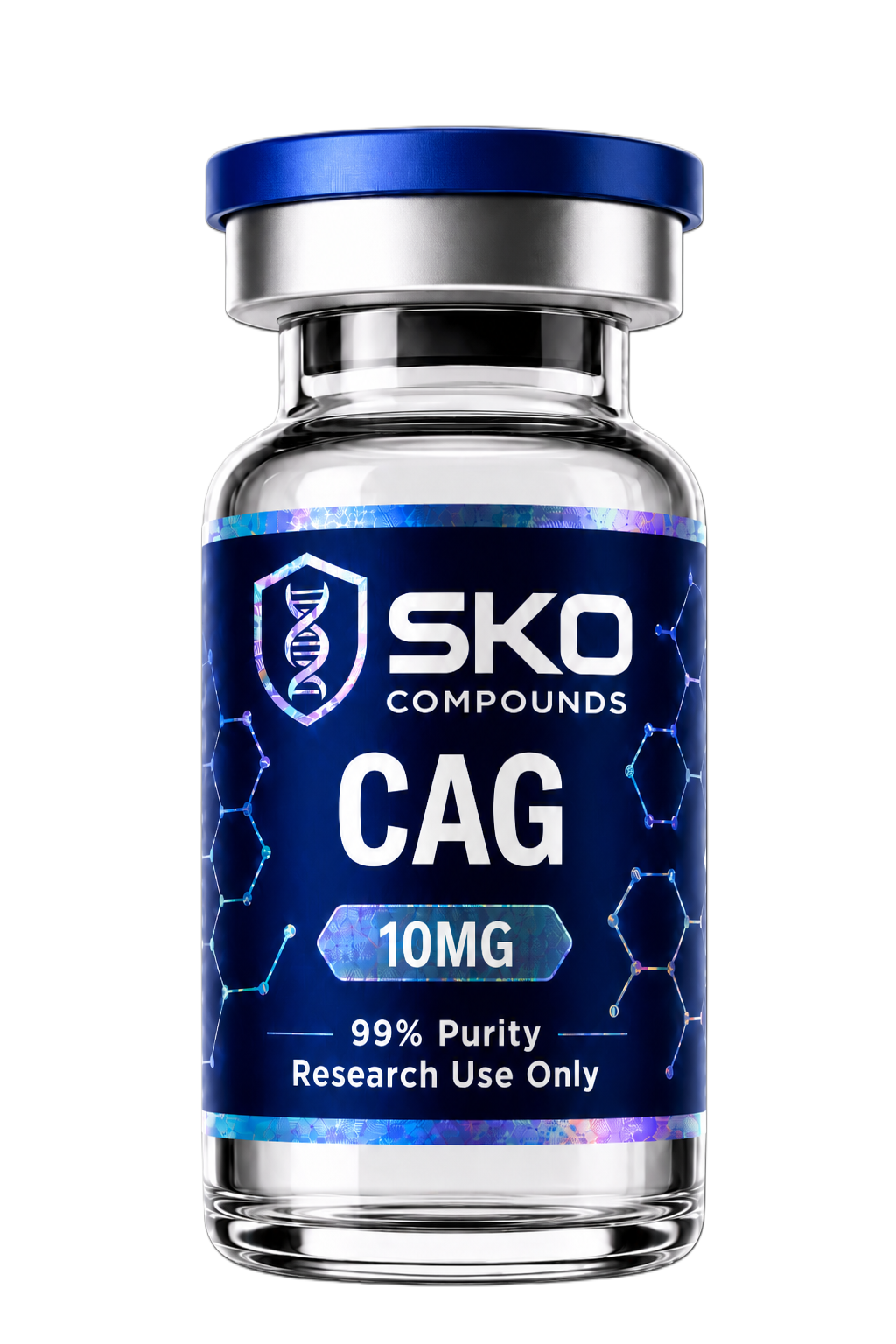
Cagrilintide
Cagrilintide (CAG) is a long-acting acylated amylin analogue engineered for extended half-life through fatty-acid conjugation. In preclinical research it has been studied as a selective amylin and calcitonin receptor agonist, investigated for its role in satiety signaling, gastric emptying modulation, glucagon suppression, and body-composition remodeling models, often paired with GLP-1 receptor agonists for combinatorial metabolic pathway studies.
Mechanism of Action: The Hindbrain “Stop” Signal
Unlike standard GLP-1 medications that mainly target the hypothalamus to reduce cravings, cagrilintide introduces a completely different biological pathway: [1, 2, 3]
-
- Amylin & Calcitonin Receptor Agonism: It binds to amylin receptors and calcitonin receptors located in the hindbrain (area postrema). [1, 2]
- Satiety Induction: This region manages the body’s physical “stop signal” for eating, producing a profound sensation of mealtime fullness rather than just a lack of appetite. [1]
- Delayed Gastric Emptying: It slows the rate at which food leaves the stomach, flattening post-meal blood sugar spikes. [1, 2]
- The Dual-Hormone Synergy: When paired with semaglutide in CagriSema, the two hormones hit complementary targets in the brain. This combination produces an additive effect that reduces food intake far more effectively than either drug can achieve on its own. [1, 2, 3, 4, 5]
Clinical Performance (REDEFINE & REIMAGINE Programs)
Cagrilintide has demonstrated remarkable efficacy in its Phase 3 global clinical trials: [1]
-
- Obesity Outcomes (REDEFINE 1): In data published from the core clinical program, the CagriSema combination (2.4 mg cagrilintide / 2.4 mg semaglutide) led to an average bodyweight loss of roughly 20% to 24% over 68 weeks. Over 91% of patients in the trial achieved a total weight reduction of 5% or more. [1, 2, 3, 4, 5]
- Type 2 Diabetes Outcomes (REIMAGINE 3): Data released from the REIMAGINE trials demonstrated that CagriSema achieved an impressive 1.8% to 1.9% reduction in HbA1c alongside robust weight loss in patients struggling to manage blood sugar on basal insulin—all without increasing the risk of hypoglycemia. [1, 2]
Regulatory Status and Compounding Restrictions
-
- FDA Review Timeline: Cagrilintide is not yet FDA-approved. Novo Nordisk officially submitted its New Drug Application (NDA) for CagriSema to the FDA, with a regulatory decision and potential approval expected to conclude later this year. [1, 2, 3, 4]
- Strict Federal Compounding Bans: The FDA has issued explicit warnings stating that cagrilintide cannot legally be used in compounding. Because it is a proprietary, unapproved investigational molecule with no FDA-approved commercial equivalent, any black- or gray-market versions sold online via telehealth or peptide companies are entirely unregulated, untested, and unauthorized. [1, 2, 3]
Side Effects and Clinical Precautions
The safety profile mirrors other incretin-based weight loss therapies, with side effects being predominantly gastrointestinal.
-
- Common Reactions: Mild-to-moderate nausea, diarrhea, vomiting, and constipation, which typically peak during initial dose escalation and fade over time.
- Serious Risks: Clinical monitoring includes tracking for rare but severe conditions like pancreatitis, gallbladder disease, and an elevated resting heart rate.
- Contraindications: Due to its powerful slowing effect on the gut, it is highly discouraged for individuals with pre-existing severe gastroparesis. It should also be avoided by anyone with a personal or family history of medullary thyroid carcinoma.
Would you like to explore the upcoming head-to-head clinical trial results comparing CagriSema directly to Eli Lilly’s tirzepatide (Zepbound/Mounjaro)? Alternatively, I can provide more details on how to safely enroll in active Phase 3 clinical trials.
Reviews
There are no reviews yet.