
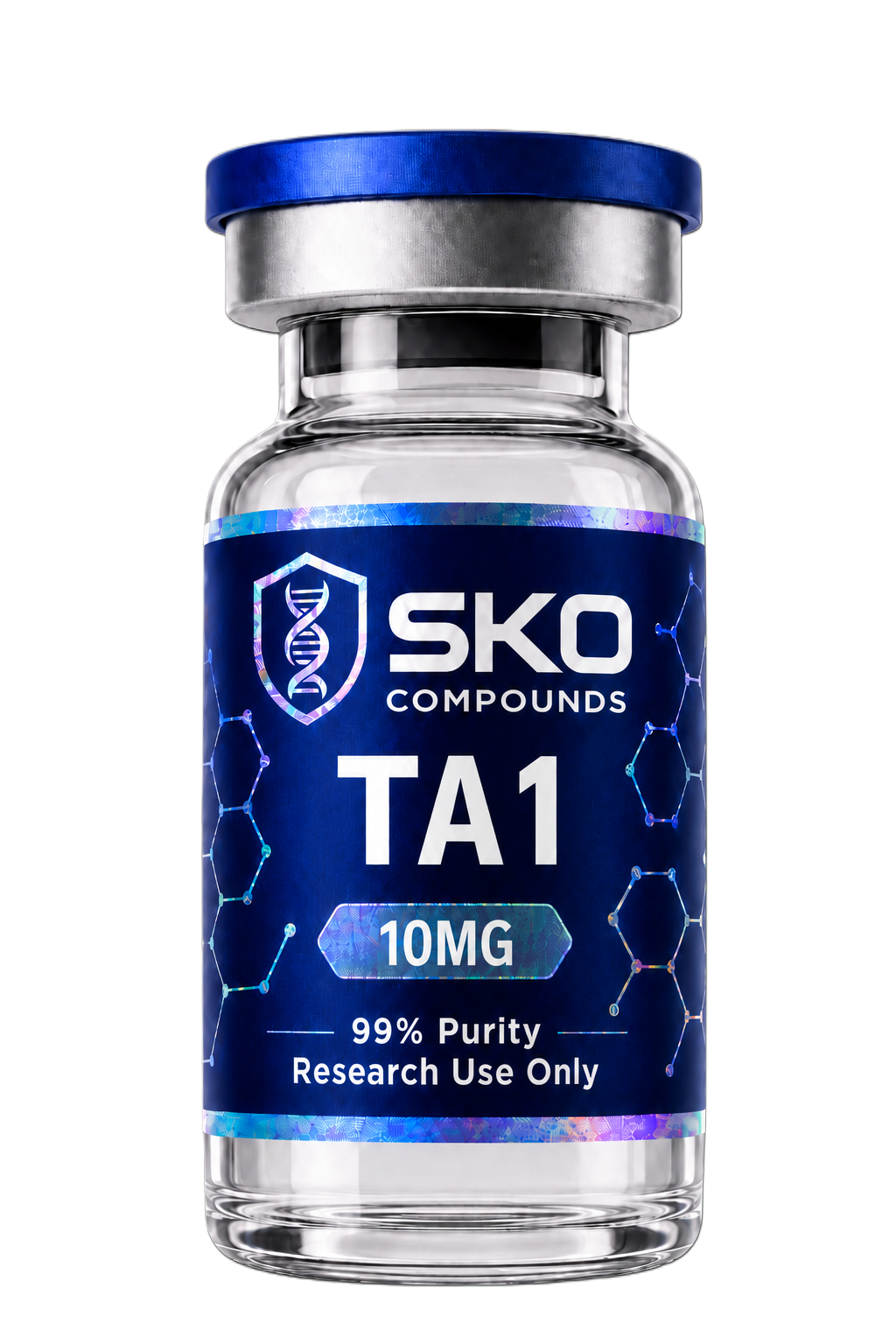
Thymosin Alpha-1
hymosin Alpha-1 (TA1) is a 28-amino-acid acetylated peptide originally isolated from thymic tissue. In preclinical research it has been studied as a Toll-like receptor (TLR2/TLR9) modulator investigated for maturation of T-lymphocytes, dendritic cell activation, cytokine expression profiles, and modulation of innate and adaptive immune signaling pathways.
Overview
The main aim of initial research into Thymosin Alpha-1(4) was to understand and examine the immunomodulating potential of the peptide. Studies have suggested that the peptide may increase the concentration of the major histocompatibility complex (MHC) class I and cytokine production, which may possibly lead to increased immune responses. The peptide may also enhance the activity of natural killer cells and foster the expression of phenotypic markers on T cells, suggesting a multi-faceted role in modulating the immune response. The researchers posited that the peptide may also increase the expression of high-affinity receptors for interleukin-2. This could potentially lead to a more vigorous activation and proliferation of T lymphocytes.
Researchers speculate that Thymosin Alpha-1 may stimulate possible action by targeting the T-helper cells and cytotoxic T-cell populations.(3) Tα 1 may possibly induce differentiation of the T-cells (thymocytes) and the terminal differentiation of the blood lymphocytes. Scientists posit that it may elevate the production of the natural killer cells and potentially stimulate cytokine mediated inflammation.(2)(3) Furthermore, the peptide has been studied for its potential to enhance efficiency of macrophages and functions as the modulator of the alpha thrombin activity.(3)
Specifications
Molecular Formula: C129H215N33O55
Molecular Weight: 3108.31 g/mol
Other Known Titles: TA1, Tα1, Thymalfasin
Research and Clinical Studies
Thymosin Alpha-1 Peptide and Immune System
In a clinical study,(5) 11 test subjects with different immune system dysfunctions were evaluated for the levels of their natural killer (NK) and lymphokine activated killer cells (LAK) present in their system. It was noted that the immunodeficient subjects demonstrated the mean LAK-cell activity of approximately 65% as compared to the control subjects. Upon presenting Thymosin Alpha-1 to the test subjects, researchers observed that it did not significantly improve the levels of NK or LAK cells. Only 3 test subjects were reported to exhibit improved LAK-cell activity by up to 30% whereas others were not significantly impacted.
Thymosin Alpha-1 Peptide and Hepatitis
Clinical trials were conducted in test subjects with liver complications, with some exhibiting Hepatitis B & C. Tα 1 was presented to the subjects to explore its potential mechanism of action on these complications.(2) For subjects exhibiting Hepatitis B, it was reported by the research team that when these subjects were presented with Thymosin Alpha-1 twice a week for the duration of the study, the reported virological response rate of the subjects appeared increased by 40.6%. For Hepatitis C, subjects reportedly exhibited improved results when Tα 1 was present in combination with interferon alpha compounds. Thymosin alpha-1’s apparent role in modulating the immune system was further explored through its potential engagement with toll-like receptors (TLR)-2 and TLR-9 on dendritic cells and other antigen-presenting cells. This interaction potentially initiates a cascade of immune responses, including the stimulation of cytokines such as interleukin-2 (IL-2), IL-10, and interferon-gamma (IFN-γ), which in turn may support the adaptive immune system. Such modulation is crucial not just for combating infections but also for controlling inflammatory responses, potentially benefiting chronic hepatitis and acute pancreatitis due to its apparent actions on cytokine profiles. In murine models and in vitro studies, Thymosin alpha-1 has been shown to possibly stimulate T-cell maturation and enhance the efficacy of natural killer cells. It might also play a role in reducing inflammatory cytokines such as tumor necrosis factor-alpha, which could be particularly beneficial in chronic inflammatory models.
Thymosin Alpha-1 Peptide and Sepsis
In a 2015 study,(6) a meta-analysis was conducted where all the relevant clinical trials prior to 2014 were analyzed to understand the possible mechanism of Thymosin Alpha-1 in relation to the sepsis reaction. In this study, 12 controlled trials were evaluated in total. Based on the extracted data and assessment, it was observed by the research analysts that there was a reported significant decline in mortality rate amongst test subjects following introduction to Thymosin Alpha-1. Subsequent studies and systematic reviews, such as those conducted by Yu et al., have supported the hypothesis that Tα1 could alleviate the immunosuppression associated with severe sepsis. However, all these studies were conducted on an exceedingly small pool of test subjects. Given the complex immune dynamics during sepsis, characterized by an initial hyperinflammatory response followed by a phase of immunosuppression, it is plausible that Tα1’s potential could be highly dependent on the timing of exposure. Addressing this aspect, further investigations are required to establish a more detailed understanding of how Tα1 influences immune pathways during different stages of sepsis.
Thymosin Alpha-1 Research with HIV
A study(7) consisted of a randomized phase II open-label clinical trial on 20 clinically stable test subjects. These patients were already undergoing highly active antiretroviral (HAART), alongside which Thymosin Alpha-1 peptide was presented to monitor the impact of the combination. Thymosin Alpha-1 was presented two times in a week in 13 subjects. The remaining 7 subjects were given placebo. Every 2 weeks, the cell counts of CD4/CD8 cells, CD45 cells and signal joint T-cell receptor circles (sjTREC) levels were monitored. After 12 weeks, it was reported by the researchers that there were no apparent significant changes in the levels of CD4, CD and CD45 levels in both the peptide or the placebo group. However, the sjTREC levels reportedly increased in the subjects presented with the peptide. These elevated levels of sjTREC might potentially stimulate immune responses. This increase in sjTREC levels hints at the possibility that Thymosin Alpha-1 may contribute to immune reconstitution by enhancing thymic output. However, this change did not correspond with an increase in total T-cell numbers or significant changes in the proportions of naive and memory T-cell phenotypes. Researchers posited that while the rise in sjTREC levels might indicate a modest improvement in thymopoiesis, the overall recovery and functionality of the T-cell compartment appeared largely unchanged within the duration of this study.
Thymosin Alpha-1 and Cancer Cells
In a study,(8) the levels of the reactive oxygen species (ROS) were monitored in test models after the presentation of Tα 1. During this study, Thymosin Alpha-1 was presented in mice with liver carcinoma. Both the leukomonocytes and HepG2 cells, given the peptide, were isolated from the mouse spleens, for the purpose of this study. Upon analysis, it was observed by the researchers that the ROS level appeared to be significantly higher in the isolated leuko-monocytes, whereas it was apparently lower in the HepG2 cells. Also, the peptide appeared to possibly increase the levels of the leuko-monocytes, whereas it may have delayed the cell cycle for HepG2 cells and thereby reduced their levels in the system. The study also delved into the possible molecular pathways affected by these changes in the redox state. Particularly, the Akt signaling pathway, known to be influenced by ROS, was examined. It was found that in HepG2 cells, there was a dephosphorylation of Akt at Ser473 following Tα1 exposure, suggesting a decrease in Akt activity associated with lowered oxidative stress. This dephosphorylation of Akt might underpin the reduced proliferation seen in these cancer cells.
Another laboratory study focused on lung cancer cells (A549), in order to investigate the potential of Thymosin Alpha-1 on cell proliferation, antioxidant enzyme activities, and cell migration.(9) The study’s findings suggest that Thymosin Alpha-1 potentially exhibits an anti-proliferative action on A549 cells, particularly at concentrations of 24 and 48 μg/mL, which apparently led to a reduction in cell viability after 24 hours of exposure. Additionally, Thymosin Alpha-1 is posited to enhance the activity of several key antioxidant enzymes. For instance, increases in the activity levels of catalase were observed at concentrations of 12 μg/mL, suggesting a possible strengthening of the cells’ oxidative stress response. The activities of superoxide dismutase (SOD) and glutathione peroxidase (GPx) also showed possible enhancements at concentrations of 6 and 12 μg/mL. These findings indicate that Thymosin Alpha-1 might contribute to the cellular antioxidant defense by mitigating the adverse actions of reactive oxygen species (ROS). Regarding cell migration, Thymosin Alpha-1 potentially inhibits the migration of A549 cells in a concentration-dependent manner, as indicated by scratch assays. In terms of ROS production, the study suggests that Thymosin Alpha-1 might lead to a reduction in cellular ROS levels, and this outcome further supports the notion that Thymosin Alpha-1 could play a role in moderating oxidative stress within cancer cells.
Reviews
There are no reviews yet.